
In 2025, I burned through $1,200 worth of AI API tokens to develop an app that charged users $10 a month. Fast forward a year, I constantly see AI initiatives fall into the same traps that got me: hidden costs, failed experiments, and unclear ROI. I’m here to share the hard-won lessons on AI strategy for business leaders that I took from surviving all that, so you don’t have to.
At Aloa, my team and I help businesses turn AI ideas into fully functioning systems that create real value. We take a full 360-degree look at a company’s operations to identify where AI can realistically improve performance. The in-depth understanding we get from this lets us validate ideas quickly through prototypes before building scalable solutions that integrate with your existing workflows.
We also have a vested interest in advancing the understanding of AI with case studies, technical deep-dives, and guides like this one. Here, I’ll share what I learned about AI leadership, including how to figure out what’s worth building, and how to deploy what you’ve built without wasting effort and cost.
TL;DR
- Good AI leadership starts with recognizing that both AI and humans have a part to play in the modern workplace: AI excels at processing data, but humans know best when it comes to deciding what matters.
- Solve your high-value problems first. Friction points like operational costs or customer trust are the best places to apply AI to create measurable impact.
- Piloting with a small team and simple tools lets you prove value quickly. Use those early wins to gain stakeholder confidence and secure further investment.
- Make sure your tech stack, your team, and your vendors are ready and capable of supporting your AI initiatives.
What is the Potential of AI Strategy For Business Leaders?
The biggest impact of AI strategy for business leaders is a revolutionary mindset shift: instead of having to be the person with all the answers, you simply have to be the person asking better questions. Artificial intelligence isn’t going to replace your brain, but it’s very good at information processing.
Think about it: AI can analyze patterns across millions of data points while you're still reading the executive summary. Leaders don’t have to compete with that.
As a leader, your role shifts to directing AI, interpreting its analysis, and applying human judgment where machine intelligence falls short. Learning AI as a leader is less like learning how to be a chess master moving pieces. It’s more like being a chess coach, teaching your team how to make the smartest moves with the pieces they’ve got.
Here’s what successful AI leaders actually do differently:
- Get their hands dirty: They use the tools themselves and understand the limitations firsthand.
- Create a learning culture: Failed experiments turn into learning opportunities, not career-ending mistakes.
- Bridge tech and business: The best AI leaders understand how data science algorithms relate to business outcomes. They can explain why a 95% accuracy rate might still be terrible for a specific use case, or why that flashy AI demo won't scale.
Evaluating and Implementing AI Strategy for Business Leaders
Like many other developers, I’ve also fallen victim to shiny object syndrome. Months wasted perfecting features nobody needed, while obvious problems went unsolved. Here's how to avoid that trap.
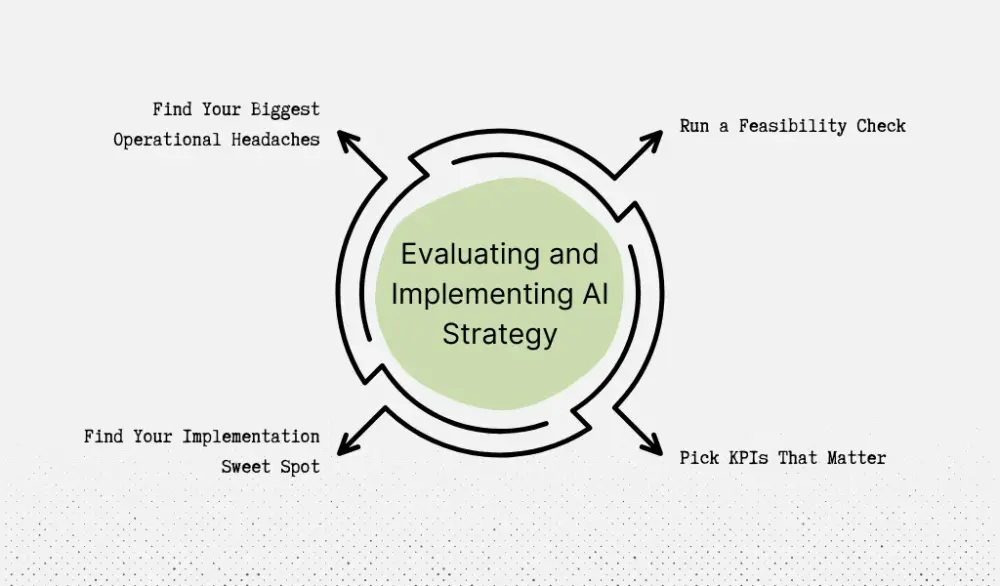
Find Your Biggest Operational Headaches
I've seen decisions get delayed for weeks because data lives in five different systems. Operational inefficiencies create more mind-numbing busywork than is necessary, especially if you have customer touchpoints that require manual handoffs between departments, force customers to repeat information multiple times, or take days to resolve simple requests.
Hone in on these friction points and try to quantify what you need to invest to smooth them over. If you can't put a dollar figure or time cost on the problem, it's not ready for AI.
Run a Feasibility Check
Before starting any AI project, I ask myself these three questions:
- Do I actually have the data? No data means no AI. Period. And I mean quality data that's actually accessible, not some theoretical dataset locked in a warehouse somewhere.
- How complex is the solution? If it takes six months and a team of PhDs to build, you're probably overengineering it. The best AI implementations are embarrassingly simple.
- Will people actually use it? I've seen technically perfect AI solutions fail because nobody asked the end users what they actually needed. If it doesn't make someone's job easier, it's dead on arrival.
Pick KPIs That Matter
This is where most people mess up. They get excited about "AI adoption rate", or "models deployed", or other metrics that sound impressive when presenting KPI metrics in presentations but mean nothing to your CFO.
Pick metrics that directly tie to money, such as:
- Revenue per employee
- Customer acquisition cost
- Processing time
- Error rates
If the AI reduces invoice processing from 3 days to 30 minutes, that's a real difference. If it cuts customer churn by 15%, that's real. Everything else is just expensive experimentation.
Google found that companies obsessing over business metrics (not fancy AI accuracy scores) actually make money. Makes sense, right? MIT’s research backs this up, showing that organizations that let AI help them discover new KPIs (not just track old ones) see better ROI.
Find Your Implementation Sweet Spot
I've watched too many companies burn millions trying to build proprietary AI from scratch when a $50/month tool would've solved their problem. Start small, prove the value, then use those wins to fund the bigger bets. Nobody's going to give you budget for your moonshot if you can't show them a working prototype first.
The projects that actually ship have three things in common:
- Solve one specific problem: Not "transform our entire customer journey" but "auto-categorize support tickets."
- Use existing tools: No custom generative AI models, no fancy algorithms, just proven solutions applied to your data
- Show results fast: If you can't prove business value in 3-6 months, you'll lose momentum and budget
The next time you see a competitor launch some flashy AI feature, don’t panic. You don’t have to AI-ify everything. Just fix the processes that are bleeding money. Salesforce says the same thing: successful companies narrow down to projects that can be implemented in less than 6 months with off-the-shelf AI solutions and minimal data cleanup.
Practical Tactics for Successful AI Deployment
Here’s the truth: AI isn’t magic. It’s incredibly powerful, but only if it’s applied to the right problems, supported by the right infrastructure and the right people. After realizing that, my team and I were able to ship products that delivered measurable business outcomes instead of just flashy demos. We did that by using these tactics:
Explore the Technology (Without Getting Distracted by Hype)
Before committing to any AI project, take the time to understand the technologies involved and what they’re actually good at.
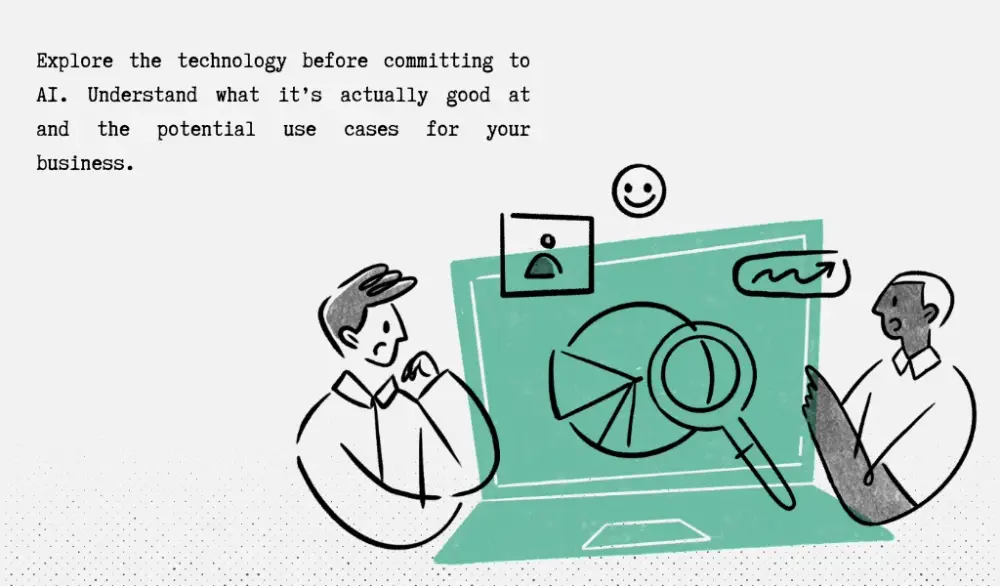
That means not just knowing the differences between tools like gen AI, natural language processing, and machine learning, but also knowing what potential use cases they can bring to your business.
While doing a deep dive into the tech, ask yourself these guide questions:
- What problems are these tools actually solving for other companies?
- Which of your own bottlenecks or inefficiencies can these tools solve?
- Which departments would work best with which tools?
Sticking to the direction these guide questions lead you towards keeps you from chasing trends and ensures that the tech you choose actually fits the problems you’re trying to solve.
Find High-Value Problems That AI Can Solve
Remember, AI is the means, not the end goal. Define your business problems, then look for AI tools that could measurably solve them. If you can’t think of a specific problem off the bat, think of what metrics could use improvement. Are you losing revenue to operational costs? Or do surveys show that you’re bleeding customer trust because of long response times?
Once you’ve found some high-value use cases, consider whether a simple automation system could solve the problem for a lower cost. AI delivers the most value with larger, more complex challenges like analyzing large datasets and personalizing customer experiences.
Make Sure Your Tech Stack is Up to Snuff
Before writing any code or signing any contracts, ask yourself whether your infrastructure can actually support an AI system. Can it handle 10× the API calls? Is your data accessible, or buried in a legacy system from 2003?
Beyond just looking at your tech, you should also consider the people who will keep your new AI tools running. Is your internal IT and engineering talent ready to maintain an AI pipeline?
I’ve seen projects fail simply because no one checked whether the infrastructure could support AI workloads. It’s like trying to run a Ferrari engine in a golf cart. It doesn’t matter how sophisticated your AI is if your servers and data pipelines can’t keep up.
Carefully Vet Your Vendors
If you’re building something as complex as an AI tool, you’re probably not going to build the whole thing in-house. Chances are you’re going to rely on a mix of vendors, tools, and APIs. This is great for speed and flexibility, but it also introduces dependency risks. Here’s what you should look at in terms of risk management:
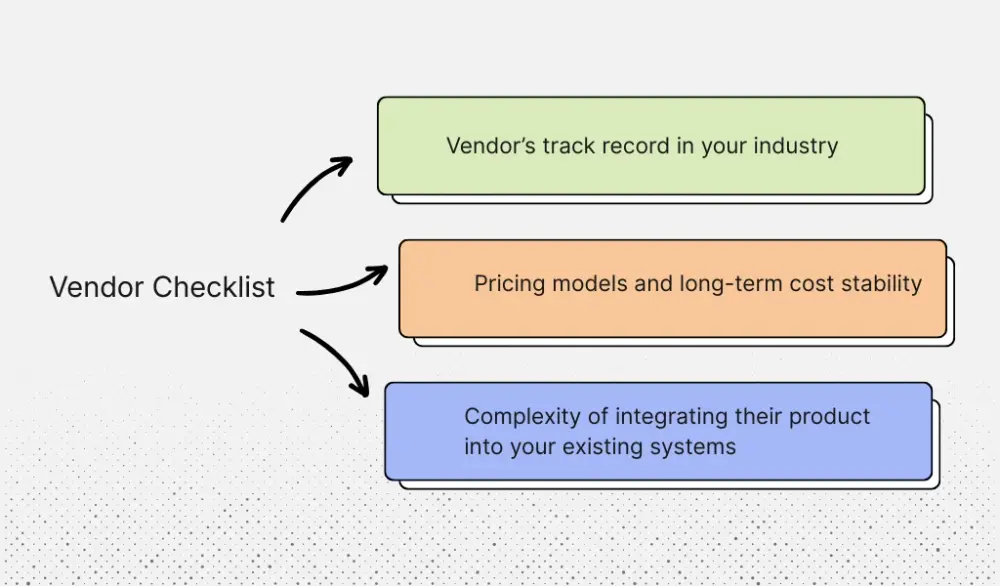
- The vendor’s track record in your industry
- Pricing models and long-term cost stability
- How complex it would be to integrate their product into your existing systems
More than once, vendors have changed pricing, rate limits, or models on me with practically zero warning. When your product depends on those services, changes like that can break workflows overnight or force expensive redesigns.
Start Small, Scale Fast
One of the biggest mistakes you can make is trying to deploy AI across too many departments too quickly. The tool you’re developing might seem ready in testing, but just before a wider rollout, you might find more than a few critical bugs that slipped through the cracks.
To avoid that, prioritize a few projects that can deliver clear value quickly. Start with a small group of users, validate the workflow, and fix problems while the stakes are still low.
These early wins build internal confidence and make it much easier to secure support and investment from stakeholders when it’s time to scale the system across the organization.
Secure Stakeholder Confidence
This is the part I can’t really overstate, even as the CEO of an AI development agency: getting stakeholder confidence, not just buy-in, as early as possible is how you ensure that your AI initiative will actually maintain its momentum. Even the best AI system will fail if it doesn’t have the support of both leadership and teams. Here’s how you secure that:
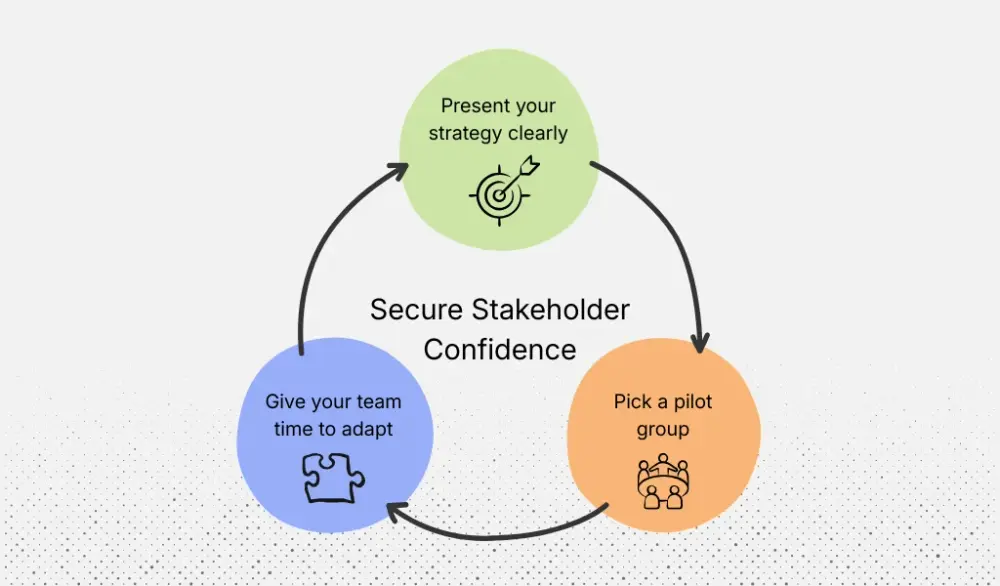
- Present your strategy clearly: Explain what problems the AI tool solves, what it will cost, and what results you expect.
- Pick a pilot group: Start with a small group of your most motivated team members. Let them experiment and refine the process before rolling it out across the entire organization.
- Give your team time to adapt: Developing confidence in a new tool won’t happen overnight. Allow your team the time and space to learn new workflows, test different use cases, and come to grips with how the technology is meant to fit into their daily work.
Monitor, Adapt, and Stay Ahead of Changes
This may sound counterintuitive to some, but even though they promise a lot of automation and operational efficiency, AI systems are anything but a “set it and forget it” solution. Once deployed, they still require ongoing monitoring, adjustments, and occasional redesigns as conditions change.
You’ll be in a much better position to improve and scale your system if you track key metrics from day one:
- Usage patterns
- Error rates
- Model performance
- Real business impact
Monitoring these metrics helps you understand not just whether the system works, but whether it’s actually delivering the value you expected.
Also keep an eye on API pricing changes, new model releases, and vendor updates. AI technology evolves quickly, and your strategy needs to evolve with it.
Mastering Advanced Decision-Making with AI
AI is meant to make your decisions better, not make decisions for you. Here’s how you can best use it:
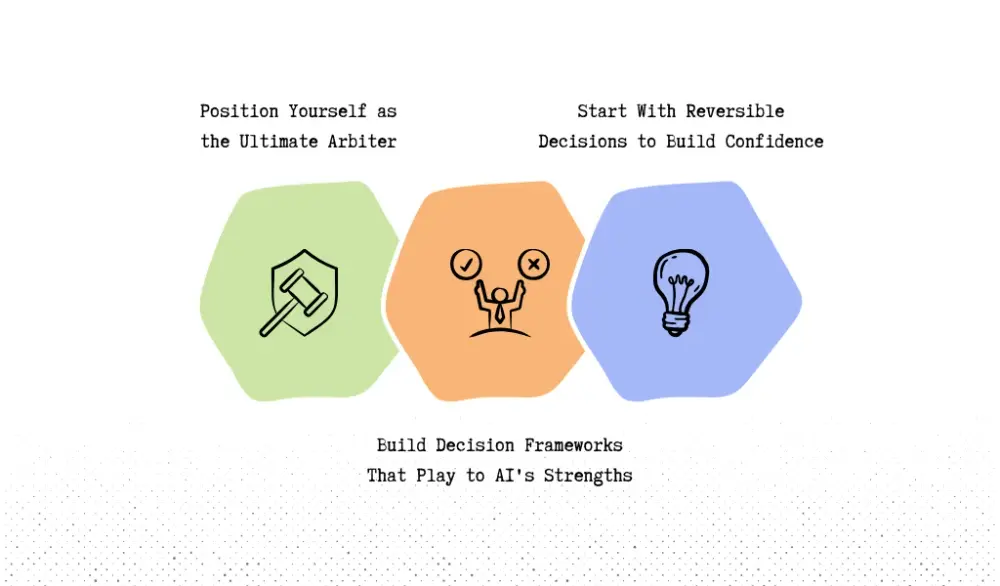
Position Yourself as the Ultimate Arbiter
Here’s a real-life example: When I use AI to timebox my day, it analyzes task priorities, deadlines, and even suggests optimal schedules. That’s what AI is best at. But I can still decide whether I want an important call to happen before or after my coffee kicks in. I always build off of the AI output rather than taking it as is.
Build Decision Frameworks That Play to AI's Strengths
Let AI handle data aggregation, pattern recognition, and scenario modeling. AI eliminates the noise so you can focus on interpreting results and applying judgment. For instance, when evaluating whether to expand to a new market, I'll have AI crunch competitor data, demographic trends, and market saturation metrics from dozens of sources.
AI spots patterns I'd miss, like how similar markets performed after certain regulatory changes. But I'm the one who decides if those patterns matter for our specific situation, considering factors AI can't quantify like team morale or strategic timing.
Start With Reversible Decisions to Build Confidence
Use AI for business applications that you can easily backpedal on. These include pricing optimization, marketing personalization, or customer service routing before betting the company on its recommendations.
I learned this after almost letting AI auto-adjust our enterprise pricing based on "optimal" calculations. It wanted to raise prices by 40% because our competitors charged more, not knowing that those competitors included features we removed from our offerings to reduce bloat and improve pricing. Now I only let AI suggest pricing for new features where we have no historical data.
Overcoming Challenges in AI Adoption
Most AI initiatives fail not because the technology doesn't work, but because organizations underestimate three critical barriers. Here are the best practices to work around the most common challenges of AI adoption.
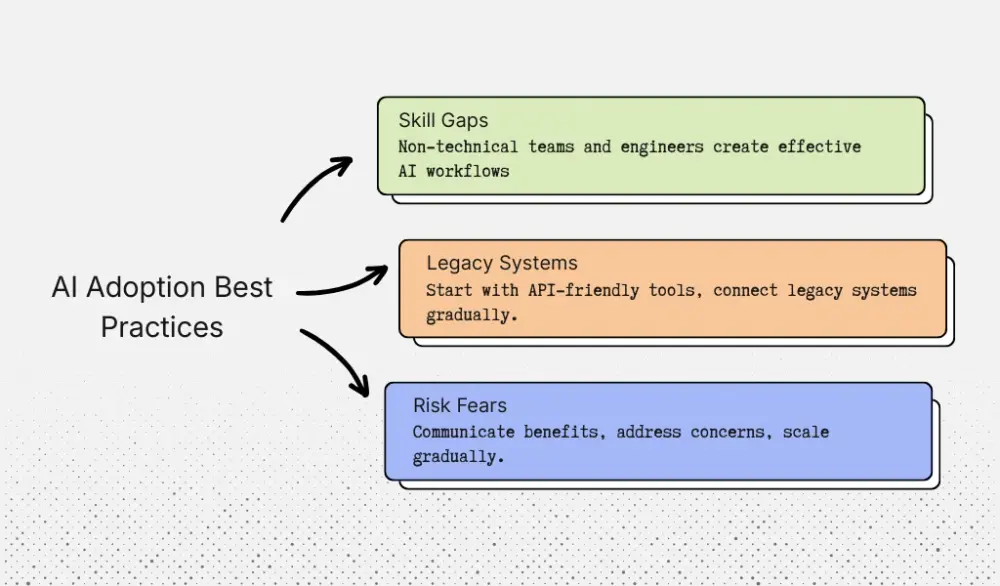
Skill Gaps
You don't need a PhD to use AI effectively. At Aloa, we've had non-technical employees build internal tools that actually work.
Sure, there are training workshops, certifications, and YouTube videos if people want to go deep. But honestly? Just get your non-technical teams talking to your engineers. Sometimes your marketing person or your customer service rep has the best ideas for AI workflows because they understand the actual problems.
The biggest wins often come from departments that aren't traditionally "technical." They see new opportunities that engineers miss because they're dealing with the messy, human side of the business every day.
Legacy Systems
As we’ve established, fixing your infrastructure is essential to enabling AI support. But like with AI adoption, it’s important to pace yourself. Don’t try to fix everything at once.
Start with API-friendly tools for new initiatives while building bridges to old systems. This hybrid approach lets you show quick wins with modern tools while gradually connecting your legacy data. This lets you ease into updating your systems to be fully AI-ready.
Risk Fears
In a survey of 1,646 employees from different companies, McKinsey found that the most common fear surrounding AI adoption is a lack of clear strategy, followed by a lack of talent and tech silos. In my experience, the best response to these fears is to address them directly.
Communicate the benefits of AI, respond to concerns as they come, and most importantly, lead by example. Launch small, learn fast, scale gradually.
How Can Aloa Help With Implementing AI at a Leadership Level
Aloa’s consulting services help leaders design and implement AI strategies that actually move the needle. That includes guiding you through leadership challenges like:
- Coordinating AI project adoption across teams and departments.
- Scaling AI without overwhelming your teams or derailing business priorities.
- Aligning tools with business strategy, rather than the other way around.
- Implementing best practices for using AI to accelerate strategic thinking.
Take it from another AI leader who’s already gone through the growing pains: you’re going to get so much more mileage out of AI if you approach it with a clear leadership framework before you even start whiteboarding. Our experiences can help you avoid the same dead ends and pitfalls that we kept running into in the early days.
Strategy and leadership alignment aren’t all you’ll be getting. We’ll help you put those concepts into practice by guiding you through practical AI implementation and execution. In 6 to 8 weeks, we’ll build working prototypes, analyze technical feasibility reports, and validate the hardest assumptions with real data. If that sounds like just what you need, reach out to us today.
Key Takeaways
AI strategy for business leaders boils down to one core rule: sensible, practical business implementation. AI is powerful, but it needs to be used thoughtfully. Just chasing flashy features is how you turn getting back ROI into an endless slog.
If you’re just starting your AI journey (or just having trouble making your initiatives stick), your next steps should be:
- Find out your top 3 operational pain points and what they’re costing you.
- Ensure your data is accessible, your tech stack can handle AI workloads, and your team and vendors are ready to support the initiative.
- Start small with motivated teams and projects that can deliver measurable impact quickly.
- Build decision frameworks that let AI do what it does best: data aggregation, pattern recognition, etc.
- Assign clear ownership of the initiative to someone who is accountable for both the rollout and the results.
The AI journey can be complex, but you don’t have to go it alone. Aloa can help you cut through the hype and implement AI solutions that work for your unique applications. Talk to us about your business goals today.
If you’d like to talk to other business leaders looking to make a big impact with AI, check out our Discord. If you’re more of a newsletter person, check out Byte-Sized. You’ll get the latest and greatest developments in the world of AI from our free newsletter.
FAQs
What's the typical ROI timeline for AI projects?
AI project timelines vary dramatically between enterprises and smaller companies, so set realistic expectations based on your scale. Small companies often see returns in 3-6 months for simple automation like chatbots because they move quickly with fewer legacy constraints. Enterprises typically need 12-24 months due to complex integrations and compliance requirements.
Should we build AI in-house or buy existing solutions?
As a rule of thumb, it’s often best to buy for common problems (customer service chatbots, sales forecasting), and build for competitive advantages (proprietary algorithms using your unique data). Most companies use a hybrid approach where they purchase foundational AI tools and customize them for their specific needs. Start with off-the-shelf solutions to learn, then build custom features as you mature.
If neither sound like they fit your technology strategy, a custom AI solution, like those we develop at Aloa, might be best for your business objectives. Our consultative, end-to-end process has been proven in major industries like fintech and healthcare.
How much should we budget for our first AI initiative?
Pilot projects typically range from $50K-$200K, including software, integration, and training. Factor in ongoing costs: cloud computing ($1K-$10K/month), model updates, and staff time. Many companies start with a small proof-of-concept under $50K to demonstrate value before larger investments.
What roles do we need to hire for AI success?
You’ll need someone skilled in AI project management who speaks both business and tech, a data engineer to prep your data, and someone to manage vendor relationships. Upskill existing staff for domain expertise. Only hire specialists once you've proven the business case.
How do we prevent AI from making costly mistakes?
Set clear boundaries on what AI can decide autonomously versus what needs human approval. Start with low-risk decisions (routing customer emails) before high-stakes ones (loan approvals). Implement monitoring dashboards to track accuracy and flag anomalies. Always maintain a "human in the loop" for critical decisions.
Can AI work with our legacy systems?
Yes, through APIs and middleware. You don't need to rebuild everything. Modern AI tools are designed to integrate with existing systems. Start by connecting AI to one system (like your CRM), prove value, then expand. Most successful implementations take a gradual approach rather than wholesale replacement.
Aloa can handle the heavy lifting of building and integrating the necessary APIs and middleware for your existing infrastructure. Our years of experience working with everyone from startups to mid-sized institutions has taught us a lot about how to ensure that AI systems scale smoothly without disrupting existing workflows.