
The conversational AI in healthcare market reached $17 billion in 2025 and is projected to grow at over 25% year over year through 2033. But here’s the catch: most projects never make it past the pilot stage. Organizations pour months into building chatbots that can’t connect to their EHR and can’t handle clinical terminology. Those tools end up collecting dust alongside last year’s innovation budget.
At Aloa, we design and build custom AI systems for healthcare organizations. Our work spans intake automation to clinical decision support tools. We’ve seen firsthand what separates the projects that reach production from the ones that stall in a demo environment.
This guide covers where conversational AI fits in healthcare workflows and why most implementations fail. It also walks through how to decide between building and buying and what a realistic timeline looks like from proof of concept to production.
TL;DR
- Conversational AI in healthcare goes beyond basic chatbots. It connects to your EHR, understands clinical context, and handles multi-turn patient and staff interactions in real time.
- The highest-value use cases span patient-facing triage and scheduling, back-office automation like insurance verification, and clinical decision support at the point of care.
- Most projects fail because of poor data integration and a lack of clinical workflow mapping. The AI model itself is rarely the bottleneck.
- Start with a proof of concept (4 to 8 weeks) to validate feasibility before committing to a full build. A realistic production timeline is 6 to 12 months.
- HIPAA compliance isn’t a feature you add later. It’s an architecture decision that shapes every layer of your conversational AI system from day one.
What Does Conversational AI in Healthcare Actually Do?
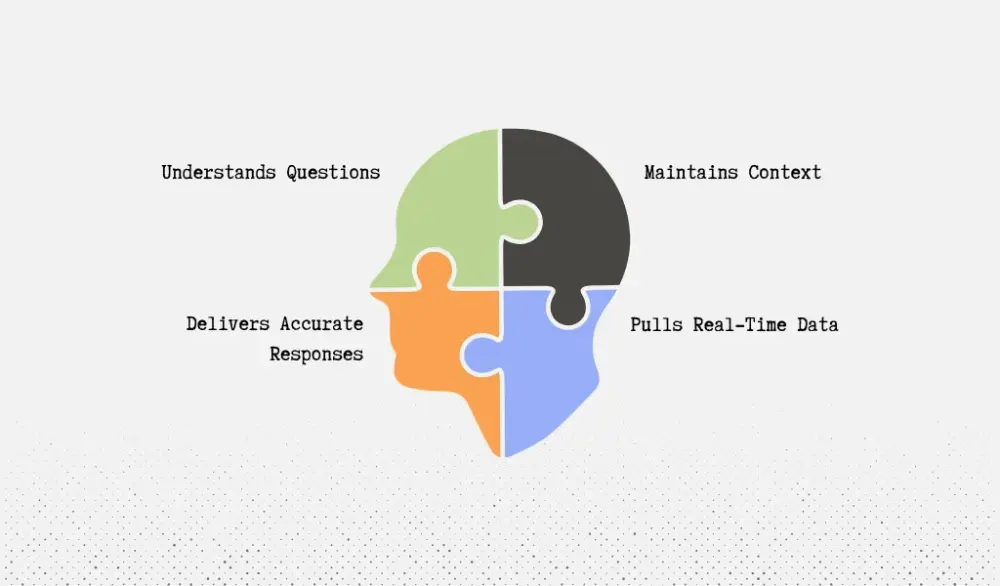
Conversational AI in healthcare isn’t a FAQ bot sitting on your patient portal. It’s a system that understands clinical context, retains conversation history across multiple interactions, and pulls live data from your electronic health records to give accurate responses.
The technology stack behind modern conversational AI solutions combines three core components. Natural language understanding lets the system parse what a patient or clinician is actually asking. Dialogue management handles multi-turn conversations without losing context. Real-time data integration pulls a patient’s medication list or appointment history mid-conversation.
What makes this different from the chatbots that hospitals deployed five years ago? Modern systems use large language models (LLMs) with retrieval-augmented generation (RAG). RAG is a technique where the AI grounds every answer in your organization’s actual data rather than relying on pre-scripted responses. That means it references your clinical protocols, your formulary, and your scheduling rules.
A 2025 Menlo Ventures report on the state of AI in healthcare found that healthcare organizations investing in AI are front-loading spend on data infrastructure and integration. The organizations seeing the highest returns are the ones treating AI as a workflow tool, not a standalone product.
That ROI doesn’t come from a better FAQ page. It comes from conversational AI platforms that are deeply integrated into clinical and administrative workflows. If you’re exploring what these solutions look like in practice, Aloa’s healthcare AI development services page breaks down the specific systems we build for healthcare organizations.
Where Does Conversational AI Fit in Clinical and Admin Workflows?
The real value of conversational AI in healthcare shows up when you map it to specific workflows. Listing features on a slide deck doesn’t get you there. Here’s where it fits, organized by who benefits.
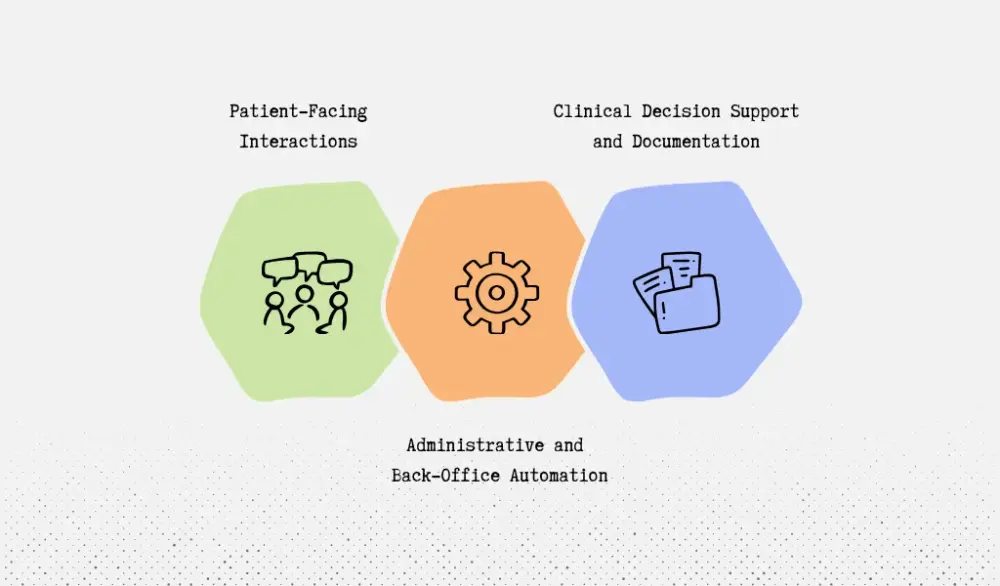
Patient-Facing Interactions
Picture a patient who just got discharged after knee surgery. They have questions about medication timing, physical therapy schedules, and warning signs that something’s wrong. Instead of calling the clinic and waiting on hold, they message a conversational AI system that already has their discharge summary and follow-up schedule.
That’s the patient-facing use case at its best: symptom triage, appointment scheduling, and post-discharge follow-up. These interactions are high-volume and repetitive. They consume enormous amounts of front desk staff time. Automating them doesn’t just cut costs. It improves patient care by making information available 24/7 instead of during business hours only.
Administrative and Back-Office Automation
Healthcare admin costs account for roughly 25% of total US healthcare spending. According to the 2025 CAQH Index, the industry avoided an estimated $258 billion in administrative costs in 2024 through electronic transactions and improved data exchange. A significant chunk of what remains goes to insurance verification, prior authorization, and billing inquiries.
Conversational AI handles these workflows by connecting to your billing and insurance systems. It does not operate as a standalone bot. When a patient asks about a claim status, the system pulls real-time data from your revenue cycle platform and gives a specific answer. When staff need to verify coverage before a procedure, the AI runs the check automatically and flags exceptions.
The key distinction: these conversational AI solutions only work when they’re plugged into your existing systems. A chatbot that can’t access your practice management software is just a fancier phone tree.
Clinical Decision Support and Documentation
This is where conversational AI crosses from convenience into clinical impact. At the point of care, AI assistants can retrieve patient records from the EHR in seconds and surface relevant clinical decision support alerts. They can also transcribe visit notes in real time. For a deeper look at these applications, see our roundup of real-world examples of AI in healthcare.
A 2026 Stanford-Harvard report on clinical AI shows that clinical AI adoption has boomed, but the systems that hold up in practice are the ones deeply integrated with EHR data. Readmission risk scoring that factors in clinical data and social determinants of health represents the highest-value application of conversational AI in healthcare. It’s also the hardest to build because it requires deep EHR integration and clinical validation before anyone will trust it.
Why Do Most Healthcare Chatbot Projects Stall?
Here’s the uncomfortable truth: the chatbot is the easy part. You can spin up a conversational AI prototype in a weekend using an LLM API and a basic prompt. Getting it to work reliably inside a healthcare organization takes months, and most teams never get there. Adoption isn’t the issue either; we’ve covered the real barriers to AI adoption in healthcare separately. The technical failures are more specific.
The Data Integration Problem
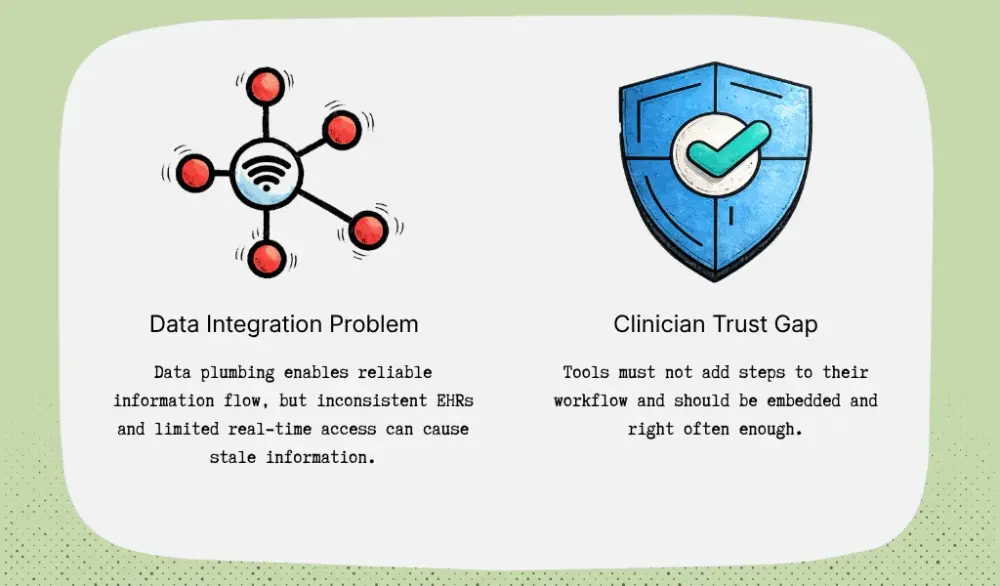
The number one reason conversational AI projects stall in healthcare is data plumbing. That’s the behind-the-scenes work of connecting systems, transforming data formats, and making sure information flows reliably between your AI and your existing infrastructure.
EHR systems like Epic and Cerner store data in different formats. Interoperability standards like HL7 (Health Level Seven, a framework for exchanging clinical data) and FHIR (Fast Healthcare Interoperability Resources, a modern API-based standard for sharing health records) exist on paper but are inconsistently adopted in practice.
Real-time data access is the kind of capability you need for a conversational AI platform to pull a patient’s latest lab results mid-conversation. That requires API infrastructure that many health systems simply don’t have.
Most teams build the AI first and figure out data access later. That’s backwards. If you can’t get clean, real-time data from your EHR, your conversational AI will hallucinate or give stale information. Start with the data layer. Confirm what you can access, how fast, and in what format. Then build the AI on top of it.
The Clinician Trust Gap
Doctors and nurses won’t use tools that add steps to their workflow. Period. If your conversational AI requires a clinician to open a separate app or re-enter patient information, adoption will be near zero. The same goes for AI-generated notes that are 80% wrong.
The fix isn’t better marketing to your clinical staff. It’s better design. Conversational AI for clinical workflows has to be embedded inside the tools clinicians already use: inside the EHR, the charting workflow, and the order entry process. It also has to be right often enough that clinicians learn to trust it. That means testing against real clinical data during the proof-of-concept phase, not after deployment.
How Do You Choose Between Building and Buying a Conversational AI Platform?
This is the decision that shapes everything downstream: do you buy an off-the-shelf conversational AI platform or do you build a custom solution?
When Off-the-Shelf Works (and When It Doesn’t)
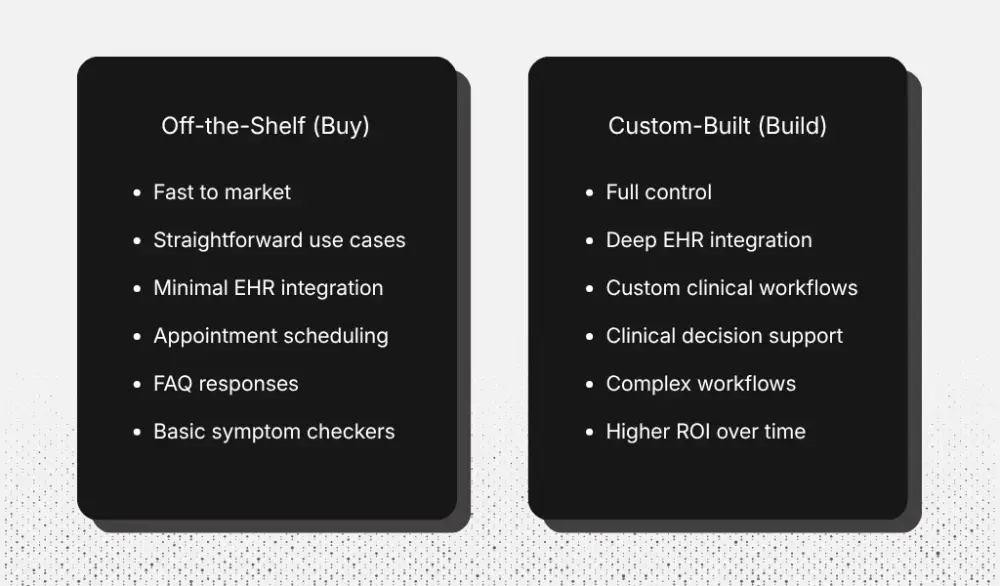
Pre-built conversational AI platforms work well for straightforward use cases: appointment scheduling, FAQ responses, and basic symptom checkers. If your needs are standard and your EHR integration requirements are minimal, a vendor solution can get you to market in weeks instead of months.
But off-the-shelf breaks down fast when you need deep EHR integration or custom clinical workflows. Fine-grained control over how patient data flows through the system is another common requirement that vendors can’t always meet. Vendor lock-in is a real risk. So is data residency: many healthcare orgs need PHI to stay within specific cloud regions or on-premises environments.
The Case for Custom-Built Conversational AI Solutions
Building custom gives you full control over your HIPAA compliance architecture and your EHR integration depth. You also get the ability to train the system on your own clinical protocols and patient data. For complex, high-volume workflows like clinical decision support or multi-step prior authorization, custom conversational AI solutions deliver a higher ROI over time.
The tradeoff is upfront investment. Custom builds take longer and cost more at the start. That’s why the smartest approach for most healthcare organizations is to validate with a proof of concept first. Test the LLM against your real data, your edge cases, and your compliance requirements. Then use that data to decide what to build custom and where an off-the-shelf component might suffice.
What Does a Realistic Implementation Timeline Look Like?
Vendor marketing will tell you that you can deploy conversational AI in healthcare in four weeks. That’s true if you’re deploying a basic FAQ bot with no EHR integration. For anything that touches patient care or clinical workflows, here’s what a realistic timeline looks like.
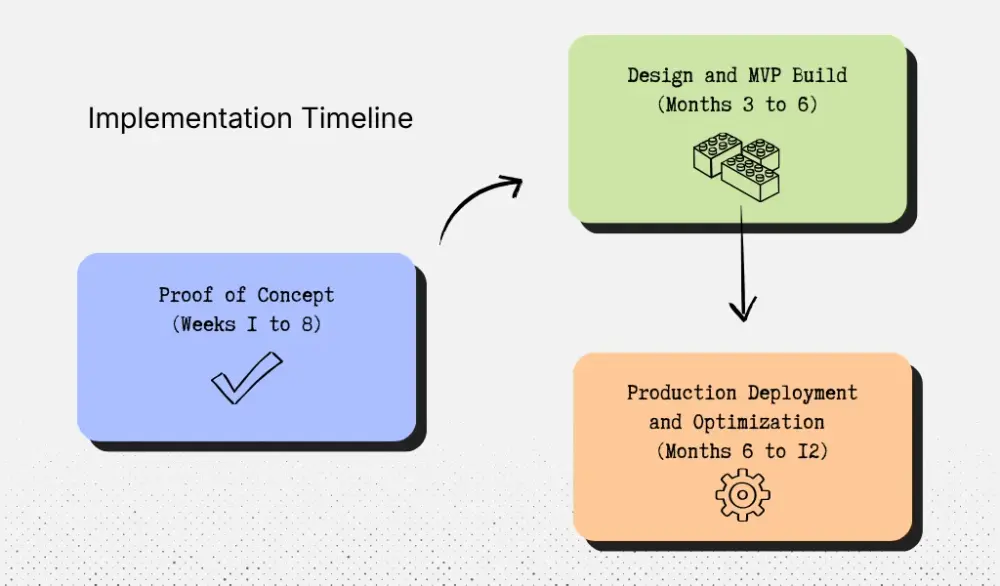
Proof of Concept (Weeks 1 to 8)
The first 4 to 8 weeks are about validating technical feasibility. Can the LLM handle your clinical terminology? Can you access the EHR data you need in real time? You also need to test your edge cases: rare conditions, complex medication interactions, and multilingual patients. If any of these break the system, you’ll know before investing in a full build.
Front-load the risk here. Test the hardest parts first. The deliverable is a working prototype that proves the concept works against your actual data, not a demo built on synthetic records.
Design and MVP Build (Months 3 to 6)
Once the PoC validates feasibility, you move into product architecture and UX design. This phase covers workflow mapping from patient input to AI response to clinical action. It also includes EHR integration with your production systems and prompt engineering and testing. You’ll build the error handling and fallback logic that keeps patient care safe.
For a conversational AI platform that touches clinical workflows, expect 3 to 6 months from validated PoC to a production-ready MVP. That includes security review, initial compliance audits, and pilot testing with a small group of clinicians.
Production Deployment and Optimization (Months 6 to 12)
Full deployment means rolling the system out across departments and training clinical and administrative staff. You’ll also need to monitor performance in production. This isn’t a "flip the switch" moment. It’s a gradual expansion with continuous optimization.
Expect to iterate on prompt accuracy, workflow integration, and user experience based on real usage data. The organizations that succeed with conversational AI in healthcare treat it as a living system, not a one-time project. For a broader look at where the industry is heading, our piece on the future of AI in healthcare covers the trends shaping what comes next.
How Do You Handle HIPAA and Compliance From Day One?
HIPAA compliance isn’t a checkbox you tick before launch. It’s an architecture decision that shapes every layer of your conversational AI system. For a deeper dive, we’ve covered AI in healthcare compliance strategies in detail. Here’s the implementation-level summary.
Technical Requirements for HIPAA-Compliant AI
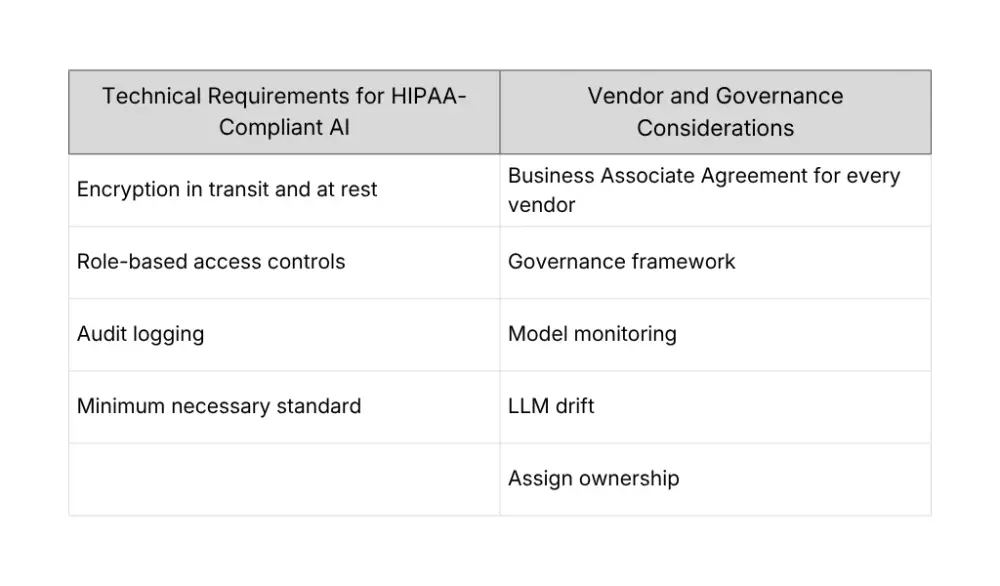
Any conversational AI platform that processes protected health information (PHI) needs encryption in transit and at rest. It also requires role-based access controls and comprehensive audit logging. You must adhere to the minimum necessary standard, meaning the system should only access the PHI it needs for a specific interaction.
Healthcare compliance mistakes cost an average of $2.3 million per incident. De-identification strategies matter too: if your AI can function on de-identified data for certain workflows, that reduces your compliance surface area significantly.
Vendor and Governance Considerations
Every vendor in your data chain needs a Business Associate Agreement (BAA). That includes your LLM provider (OpenAI and Anthropic both offer HIPAA-eligible plans), your cloud host, and your integration middleware. Miss one and you have a compliance gap.
Beyond BAAs, you need a governance framework for ongoing model monitoring. LLMs can drift. Prompts that worked last month might produce different outputs after a model update. Build monitoring into your operations from the start and assign clear ownership for AI governance within your organization.
Key Takeaways
Conversational AI in healthcare works when you treat it as a data integration and workflow problem, not just an AI problem. The technology is mature enough to handle patient triage, admin automation, and clinical decision support. But the organizations that succeed are the ones that start with their data layer and map their clinical workflows. They validate everything with a proof of concept before scaling.
At Aloa, we build healthcare AI systems with this exact approach. We start with a focused proof of concept to validate feasibility against your real data. Then we design and build production systems with HIPAA compliance baked into every layer. We’re engineers who build every day, not consultants who hand you a slide deck.
If you want a partner who can take conversational AI in healthcare from concept to production, schedule a call with Aloa. We’ll review your workflows, identify the highest-impact opportunities, and lay out a clear plan to get them into production.
Frequently Asked Questions
What is the difference between a chatbot and conversational AI in healthcare?
A traditional chatbot follows scripted decision trees and can only respond to pre-programmed inputs. Conversational AI uses natural language understanding and large language models to handle open-ended questions, retain context across multi-turn conversations, and pull real-time data from systems like your EHR. In clinical settings, that difference matters because patients don’t ask questions in predictable patterns.
How much does it cost to implement conversational AI in healthcare?
Costs vary widely depending on scope. An off-the-shelf chatbot for appointment scheduling might run $500 to $2,000 per month. A custom-built platform with EHR integration and HIPAA compliance typically requires $150,000 to $500,000+ in development investment plus ongoing maintenance. Starting with a proof of concept ($30,000 to $80,000) lets you validate ROI before committing to a full build.
What are the best conversational AI platforms for healthcare?
It depends on your use case. For basic patient communication like scheduling and reminders, platforms like Hyro and Orbita offer pre-built healthcare modules. For clinical decision support or deep EHR integration, most organizations need a custom-built solution using LLM APIs (OpenAI or Anthropic) with RAG architecture tailored to their specific data and workflows.
Can conversational AI replace doctors and nurses?
No. These systems handle repetitive, information-heavy tasks: answering patient questions, triaging symptoms, processing insurance queries, and transcribing notes. They free clinicians to focus on complex clinical judgment and hands-on patient care that AI can’t replicate. Think of it as a tool that removes busywork, not a replacement for clinical expertise.
How is conversational AI being used for mental health support?
AI-powered tools like Woebot and Wysa deliver elements of cognitive behavioral therapy (CBT), offering coping mechanisms for stress and anxiety. They provide an accessible and anonymous first point of contact. They don’t replace human therapists, but they fill a gap for people who can’t access care immediately or want support between sessions.
Can patients use general AI assistants like ChatGPT for medical questions?
Patients can and do, but general AI assistants aren’t designed for clinical use. They lack access to patient records, aren’t HIPAA-compliant, and can hallucinate medical information. Purpose-built clinical AI systems are trained on verified medical data, connected to your EHR, and include safety guardrails that general-purpose tools don’t have.
What happens if a conversational AI gives incorrect medical information?
This is the biggest risk in conversational AI in healthcare, and it’s why testing matters. Well-built systems use RAG to ground responses in verified clinical data rather than generating answers from general training data. They also include fallback logic: when the AI isn’t confident, it escalates to a human. Liability frameworks are still evolving. Thorough testing during the PoC phase and ongoing monitoring after deployment are non-negotiable.
How long does it take to integrate conversational AI with existing EHR systems?
EHR integration is usually the longest part of the project. If your EHR supports modern FHIR APIs (Epic and Cerner both do with varying levels of support), basic read access can be established in 2 to 4 weeks. Full bidirectional integration that reads and writes back to the EHR typically takes 2 to 4 months. The timeline depends on your IT infrastructure and the workflows you’re automating.